
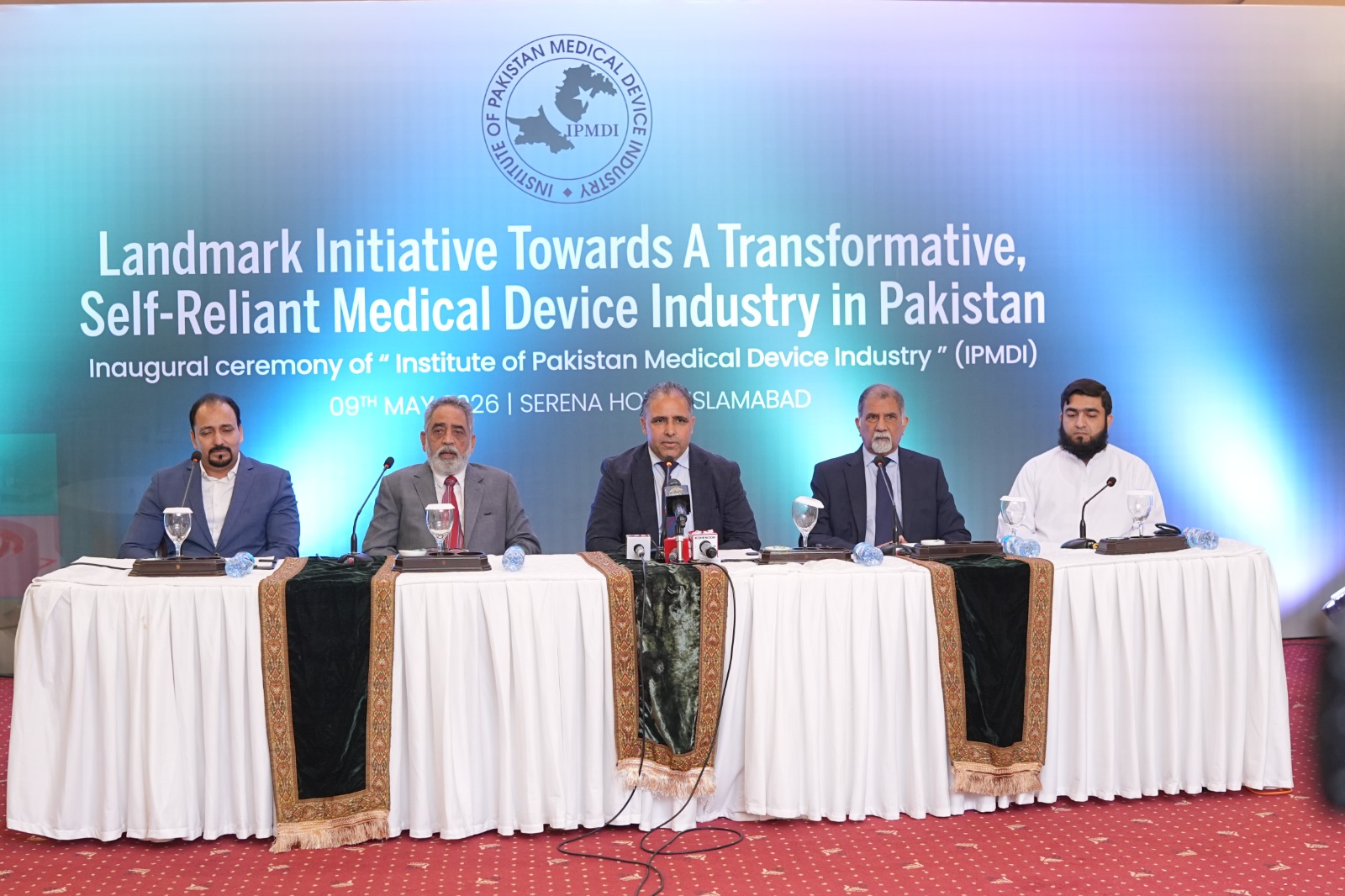
Islamabad (Umer Hayat): Pakistan’s healthcare landscape took a significant step towards industrial and public health reform with the inauguration of the country’s first national platform dedicated to the medical device sector, the Institute of Pakistan Medical Device Industry. The event brought together distinguished industrialists, academicians, policymakers, and representatives of regulatory and public health institutions, marking the beginning of a more structured national dialogue on the future of Pakistan’s healthcare manufacturing ecosystem.
The event served as a convergence point for stakeholders to strengthen Pakistan’s capacity in medical technology, diagnostics, and healthcare innovation. Throughout the proceedings, speakers candidly addressed the structural challenges confronting the industry, particularly the constraints imposed by limited resources, inconsistent industrial support mechanisms, and the pressing need for more industry-compliant and growth-oriented policies. Participants stressed that without a coherent framework encouraging innovation, investment, and local production, the healthcare sector would continue to struggle in meeting the demands of a rapidly growing population.
Representatives from key government and regulatory bodies, including the Drug Regulatory Authority of Pakistan (DRAP), the Health Services Academy (HSA), COMSATS and other prestigious national institutions, attended the inauguration and expressed strong confidence in the initiative. They acknowledged the importance of establishing a unified platform capable of shaping the strategic and operational foundations of Pakistan’s medical device industry.
One of the most widely discussed themes during the event was the critical relationship between academia and industry. Speakers highlighted that meaningful collaboration between educational institutions and the healthcare manufacturing sector is indispensable for national progress. Such partnerships, they noted, would not only facilitate research and innovation but would also contribute significantly to human resource development by preparing scholars, researchers, and students with industry-relevant expertise and practical exposure.
The discussions also carried a profound public health dimension. Participants reflected on Pakistan’s escalating disease burden, particularly the prevalence of infectious diseases such as Hepatitis C and HIV. Concern was specifically raised regarding the recent rise in HIV infections and the challenges associated with containment, diagnosis, and accessibility of treatment. In this context, speakers strongly advocated for indigenous and cost-effective healthcare solutions. It was emphasised that locally manufactured diagnostic technologies and medical devices could offer more practical, sustainable, and economically viable responses to public health crises, especially in underserved communities where affordability and accessibility remain major barriers.
Concluding remarks at the event reinforced the importance of national trust in local programmes and domestic manufacturing capabilities. Participants maintained that if initiatives targeting diseases such as Hepatitis C and HIV are actively promoted through supportive national policies, institutional collaboration, and confidence in local industry, Pakistan can substantially improve the effectiveness of its public health programmes. The inauguration of the Institute of Pakistan Medical Device Industry was therefore positioned not only as the launch of an institution rather as the beginning of a broader movement towards healthcare self-reliance, industrial resilience and a more sustainable future for public health in Pakistan.